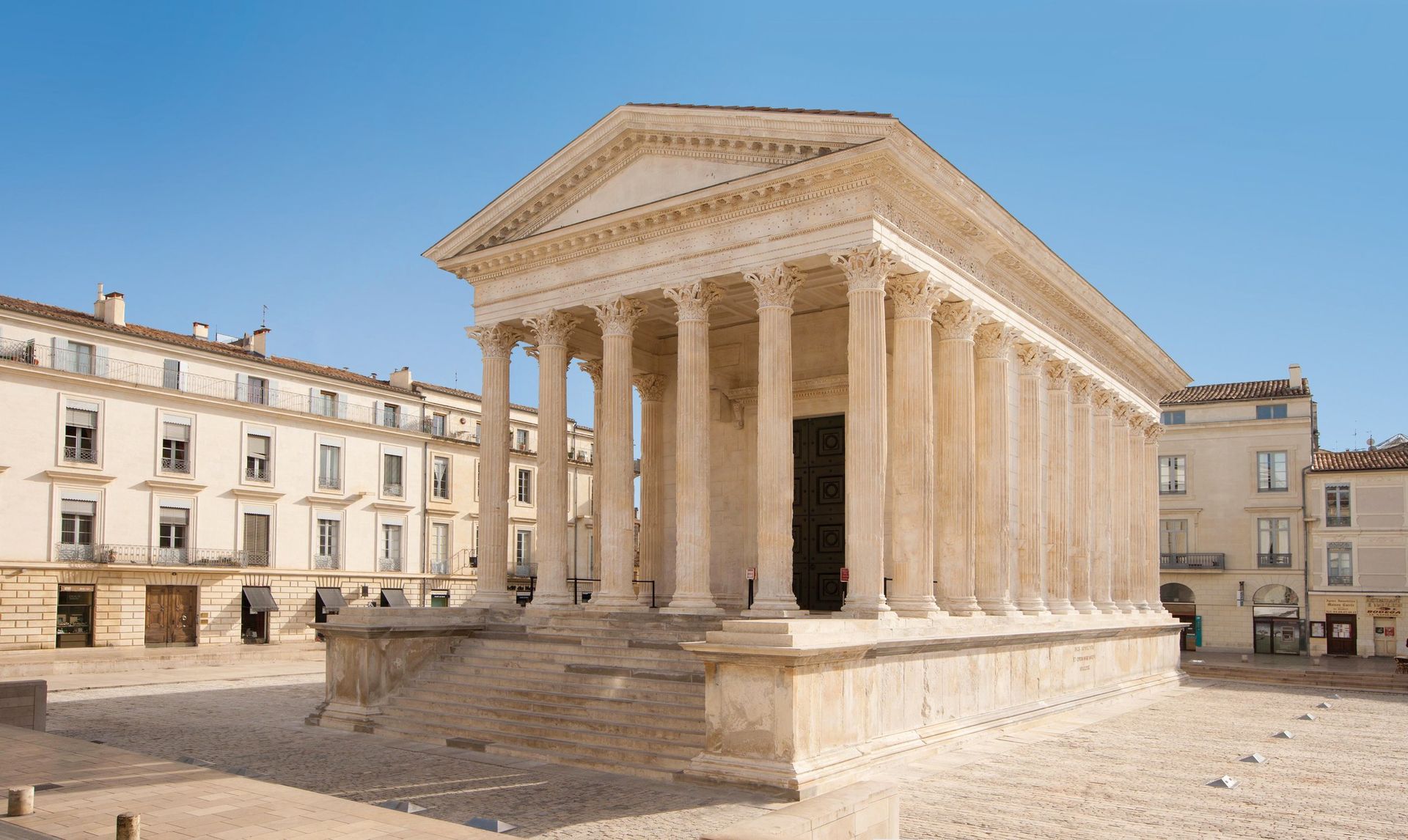
Nîmes' Maison Carrée, erected at the beginning of our era in honor of Caius Caesar and Lucius Caesar, adopted sons of Emperor Augustus, was once a central feature of the Forum, the economic and administrative center of the ancient city.
Inspired by the temples of Apollo and Mars Ultor in Rome, its harmony and proportions are captivating. One of a kind, it is the only temple in the ancient world to have been completely preserved, measuring 26 meters long by 15 wide by 17 high. Although the ceiling of the pronaos dates from the early 19th century and the current door was built in 1824, the Maison Carrée has retained its remarkable appearance thanks to continuous use since the 11th century, serving successively as a consular house, stable, apartment, church, and even as the seat of the first prefecture of the Gard after the French Revolution.
In 1823, it became Nîmes' first museum, after being converted into the departmental archives. Its square was redeveloped in 1993 by architect Jean Bousquet, Lord Norman Foster, to create a spatial unity with Carré d'Art. Restoration of the Maison Carrée, begun in 2006 and completed in 2010, was the most extensive in a century, with the aim of restoring the shine to the facades and floor exposed to weather and pollution.
Listed as a UNESCO World Heritage Site, the restoration campaign took over four years and almost 44,000 man-hours to restore this emblematic monument to its former glory. Today, the Maison Carrée in Nîmes remains an exceptional testimony to Roman engineering and architecture. Website
Find out more...
Book your car to go and see it !
🧐
Here are a few little-known facts about the Maison Carrée in Nîmes:
Cultural center: In addition to its historical importance, the Maison Carrée is today a dynamic cultural center, hosting exhibitions, events and shows, perpetuating its role as a meeting and celebration place in the heart of the city of Nîmes.
Influence on modern architecture: The Maison Carrée has also inspired many modern architects, who have been seduced by its timeless elegance and perfect symmetry. Elements of its design have been incorporated into iconic buildings around the world.
Here are a few examples:
The Jefferson Memorial - Washington, D.C., United States : The Jefferson Memorial, built in 1943 in honor of the third American president, Thomas Jefferson, is inspired by the neo-classical style, which has its origins in the architecture of Greece and Rome. The shape of the temple is reminiscent of the Maison Carrée, with its Corinthian columns and sculpted pediment.
The Maison de la Radio - Paris, France: Designed by French architect Henry Bernard and completed in 1963, the Maison de la Radio in Paris features architectural elements inspired by the Maison Carrée, notably its slender columns and symmetry. Although more contemporary in style, it clearly evokes classical Roman aesthetics.
The Capitol - Washington, D.C., United States: The U.S. Capitol, seat of the U.S. Congress, is a remarkable example of the influence of classical architecture on modern government buildings. Its imposing dome and Corinthian columns evoke the grandeur and majesty of ancient temples, including the Maison Carrée.
The Pantheon - Rome, Italy: Although not strictly modern, Rome's Pantheon, originally built in 125 AD, has influenced many modern architects. Its monumental dome and imposing façade have inspired contemporary constructions around the world, including government buildings and churches.